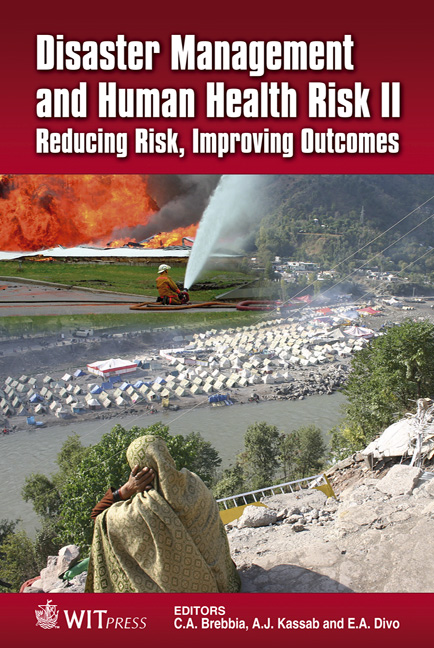
Disaster Management and Human Health Risk II
Reducing Risk, Improving Outcomes
Edited By: C.A. BREBBIA, Wessex Institute of Technology, UK, A.J. KASSAB, University of Central Florida, USA and E.A. DIVO, Daytona State University, USA
Price:
USD290.00
ISBN: 978-1-84564-536-6
eISBN: 978-1-84564-537-3
Pages: 336
Book Series: WIT Transactions on The Built Environment
Series Volume: 119
Published: 2011
hardback
Book Description
This book contains papers presented at the second International Conference on Disaster Management held in 2011 in Orlando, Florida following the success of the first meeting held at the Wessex Institute of Technology in the New Forest, UK. Florida is no stranger to the increasing number of natural disasters affecting millions of people around the world, having periodically suffered the ravages of hurricanes, with a recent disastrous sequence of four hurricanes delivering devastating blows to the State from both Gulf and Atlantic coasts in 2004. Most recently, Florida’s economy was seriously affected by the Deep Horizon oil spill in the Gulf of Mexico in spite of its coastline being mostly spared from any major damages.
The 2011 Disaster Management Conference has attracted outstanding contributions from researchers throughout the world. The collected works, published in this book, reflect the excellent work of all contributing authors and the care taken by the Scientific Advisory Committee and other colleagues in reviewing the presentations. Topics covered include: Disaster Analysis, Monitoring and Mitigation; Emergency Preparedness; Risk Mitigation; Surveillance and Early Warning Systems; Socio-Economic Issues.
Book Contents
Tsunami risk mapping simulation for Malaysia
S. Y. Teh; H. L. Koh; Y. T. Moh; D. L. DeAngelis; J. Jiang;
Physical vulnerability of critical facilities in Grand Cayman, Cayman Islands
D. A. Novelo-Casanova; G. Suárez;
Analysis and prediction of building damage due to windstorms
N. O. Nawari;
Seismic performance analysis of lifeline systems
M. Faraji; J. Kiyono;
Real-time landslides monitoring and warning using RFID technology for measuring ground water level
S. Hosseyni; E. N. Bromhead; J. Majrouhi Sardroud; M. Limbachiya; M. Riazi;
Intensity, attenuation and building damage from the 27 May 2006 Yogyakarta earthquake
P. Widodo; H. H. Wijaya; Sunarto;
Disaster preparedness under the decentralization system of governance in Uganda
B. Sserwadda;
An overview of disaster management in India
A. J. Shah;
A decision support framework for large scale emergency response
D. T. Wilson; G. I. Hawe; G. Coates; R. S. Crouch;
Assessing community and region emergency-services capabilities
Z. Shoemaker; L. Eaton; F. Petit; R. Fisher; M. Collins;
Community resilience: measuring a community’s ability to withstand
M. Collins; J. Carlson; F. Petit;
Emergency response and traffic congestion: the dispatcher’s perspective
V. P. Sisiopiku; A. J. Sullivan; P. J. Foster; P. R. Fine;
How can the risks associated with climate change help shape Lord Howe Island fire management planning
M. J. Beltran;
Catastrophic failure planning for the SR 520 bridge
G. MacDonald; D. Babuca; A. Swanson; T. Lentz; P. Scalingi;
Seismic retrofitting on structures in urban areas
A. K. Desai;
Promoting the hybrid socio-technical approach for effective disaster risk reduction in developing countries
D. Karnawati; T. F. Fathani; W. Wilopo; A. Setianto; B. Andayani;
Capturing community influence on public preparedness
F. Petit; R. Fisher; J. Yaeger; M. Collins;
The contribution of human psychology to disaster management: mitigation, advance preparedness, response and recovery
C. Percy; Y. F. Chen; A. Bibi; D. Coles-Jordan; E. Dodson; T. Evans; D. Klingberg; M. van der Bruggen;
Development of the Analytical Hierarchy Process (AHP) method for rehabilitation project ranking before disasters
M. Yadollahi; M. Z. Rosli;
An application of enterprise risk management in the marine transportation industry
M. D. Abkowitz; J. S. Camp;
Wireless network sensors that are energy efficient for monitoring and early warning
V. Ferrara;
Infectious diseases: surveillance, genetic modification and simulation
H. L. Koh; S. Y. Teh; D. L. DeAngelis; J. Jiang;
Strategies for crowdsourcing for disaster situation information
E. T.-H. Chu; Y.-L. Chen; J. W. S. Liu; J. K. Zao;
Application of Google Earth for flood disaster monitoring in 3D-GIS
M. Mori; Y. L. Chan;
Post disaster reconstruction activities: a case study in Ghana
K. Adu-Boateng; B. M. Oppong;
Best practices for psychological support of communities after a disaster
B. Selzler; D. Grandbois;
Farmers’ awareness and utilization of disaster management strategies and training needs for sustainable food security and livelihoods in Nigeria
N. T. Meludu;
(This link will take you to an external website)