
Water Resources arrow Sustainable Irrigation Management, Technologies and Policies III

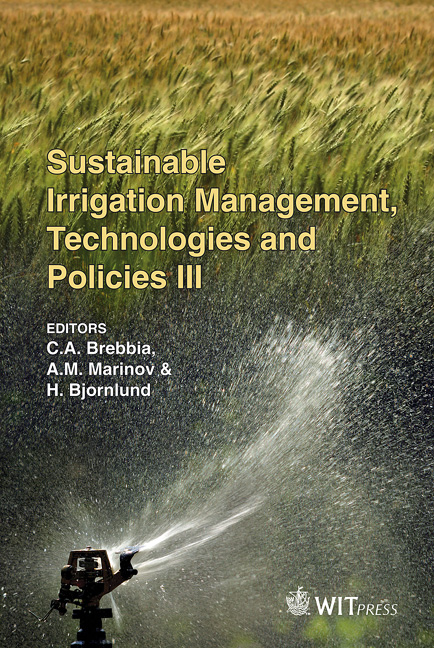
Sustainable Irrigation Management, Technologies and Policies III


Edited By: C.A. BREBBIA, Wessex Institute of Technology, UK, A.M. MARINOV, University Politehnica of Bucharest, Romania and H. BJORNLUND, University of South Australia & University of Lethbridge, Canada


Price: USD206.00
ISBN: 978-1-84564-446-8
eISBN: 978-1-84564-447-5
Pages: 272
Book Series: WIT Transactions on Ecology and the Environment
Series Volume: 134
Published: 2010
Hardback


Book Description


Fresh water is becoming an increasingly precious commodity. In the near future, control of it could lead to the type of political instability that is now associated with energy shortages. This book addresses the different aspects of irrigation, including not only the management of water resources and scientific and technical aspects, but also matters related to policy and economics. The objective of the Conference Series is to provide a venue for an international presentation and dissemination of papers related to sustainable ways of conducting irrigation. Sustainable irrigation has three key aspects, i.e.  i) developing ways of using scarce water resources most efficiently to maximize food production while minimizing the environmental impact of irrigation activities on the affected land and water resources; ii) ensuring that the extraction of water from surface and groundwater sources is set at sustainable levels to maintain healthy aquatic ecosystems to secure a continued supply of quality water for irrigation, recreation and urban/industrial uses; iii) facilitate an equitable distribution of the water available for consumption between competing users, which is essential to maintain sustainable communities. Attracting researchers in academia and industry, as well as professional practitioners and policy makers, the Third International Conference provides a platform for a review of the state of the art from the scientific, technological, political and economic points of view. Papers from the Meeting are published in this volume, and cover the following topics: Irrigation Management; Modelling and Simulation; Sustainable Irrigation – Farmers’ Actions, Environmental Benefits and Socio-economic Consequences


Book Contents


Land reclamation and water management in an arid region: a case study of Xayar county in Xinjiang Uygur autonomous region, China
T. Yamamoto; A. Jalaldin; A. Maimaidi; T. Nagasawa;

Making large gravity irrigation systems perform
G. Spencer;

Farmers’ preferences for irrigation water demand management tools: a Bayesian analysis of choice behaviour of farmers in Krishna river basin, India
P. Chellattan Veettil; A. Frija; S. Speelman; J. Buysse; G. van Huylenbroeck;

Effect of deficit irrigation and mulch on water use and yield of drip irrigated onions
A. A. Ramalan; H. Nega; M. A. Oyebode;

Magnitude yield response and economic value of selected wheat genotypes related to irrigation schedules under the arid ecosystem of Saudi Arabia
A. A. Alderfasi; A. A. AL-Owayed;

Robustness, vulnerability and adaptive capacity in social ecological systems: the case of spate irrigation systems in Pakistan
M. A. Kamran; G. P. Shivakoti;

Five thousand years of irrigation history in Iran: rituals and methods
M. Sadrzadeh; G. Badalians Gholikandi;

Decision models for better land management under cultivation
M. C. Cunha; T. Leitão; J. P. Lobo-Ferreira; L. S. G. Oliveira;

Correlation between chemo-physical parameters NH, NO, NO, SO, pH and aquifer and impervious layer electrical resistance in groundwater
G. Badalians Gholikandi; H. R. Orumieh;

Theoretical basis and significance of variance of discharge as a bidimensional variable in microirrigation lateral design
E. R. Detomini; J. A. Frizzone;

Saving irrigation water by accounting for windbreaks
T. T. de Vries; T. A. Cochrane; A. Galtier;

Rainfall data calculation using Artificial Neural Networks and adaptive neuro-fuzzy inference systems
L. Mpallas; C. Tzimopoulos; C. Evangelidis;

Design for an “engineered sinkhole” to improve, recharge and reduce evapotranspiration in an upstream flood control structure
Y. Leventeli; T. Halihan; M. Dailey; K. Hurt; W. Kellogg;

Evaluation of the Aardvark constant head soil permeameter to predict saturated hydraulic conductivity
E. Theron; P. A. L. Le Roux; M. Hensley; L. Van Rensburg;

Sustainable irrigation–a new challenge?
Y. Bjornlund; H. Bjornlund;

Path dependence and critical junctures: an urban-rural water sharing study
L. Nicol;

Modelling the adoption of different types of irrigation water technology in Alberta, Canada
S. Wheeler; H. Bjornlund; T. Olsen; K. K. Klein; L. Nicol;

Improving water use efficiency in southern Alberta irrigated agriculture: choice of criterion
K. K. Klein; S. N. Kulshreshtha; M. K. Ali; R. Bewer;

Alberta’s drive to use market-based instruments for ecosystem services provision
G. L. Kerr; H. Bjornlund;

Trade influences in Australia’s allocation market: can allocations provide environmental water?
A. Loch; H. Bjornlund;

The drought, the irrigators, and their photographs: images from the inside
G. Kuehne; H. Bjornlund;


Buy ebook from ebooks.com
(This link will take you to an external website)