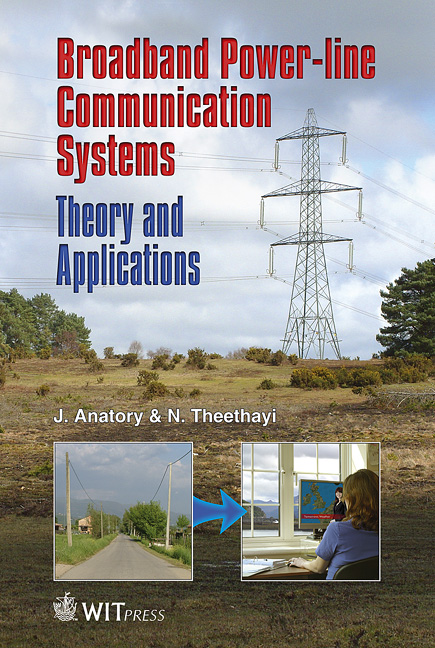

Broadband Power-line Communication Systems
Theory and Applications
Authors: J. Anatory, University of Dodoma, Tanzania and N. Theethayi, Bombardier Transportation, Sweden
Price
£90.00 (free shipping)
ISBN
978-1-84564-416-1
eISBN
978-1-84564-417-8
Pages
192
Published
2010
Format
Hardback
The advancement in information and communication technologies (ICT) has made it possible that broadband services can be used to bridge urban–rural areas efficiently and economically, using a readily available and largely distributed power-line infrastructure. Power-line networks can be used for multi-service data transmission, such as low speed data which includes office and home automation, energy information systems, transportation systems, etc. and broadband services such as ‘Last Mile’ and ‘Last Meter’ high-speed internet access, voice over Internet Protocol (IP), etc. Other applications include high-speed data communication for indoor applications such as digital entertainment systems. High capacity links in transmission systems could eliminate the need for fiber optic cables in telecommunication networks. Advancements in this field led to the evolution of the subject Broadband Power-line Communication (BPLC), which is essentially a blend of the other well known subjects, namely: classical transmission line (TL) theory, communication and networking theories. Based on these, this book covers both the theoretical and practical aspects of BPLC technology intended for graduate studies and industries dealing with PLC system design and power-line network planning/segmentation.
The topics include classification of BPLC systems, models for analyses based on TL theory, estimation of channel capacity and performance and finally application of modulation, and coding techniques for boosting the performance of BPLC systems. For the convenience of the reader a couple of chapters are dedicated to the fundamental aspects of TL, communication and networking theories which act as warm up for other chapters.