
Risk & Security arrow Flood Recovery, Innovation and Response

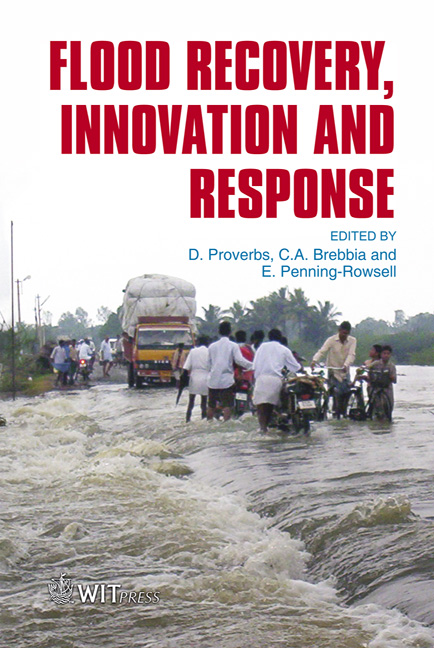
Flood Recovery, Innovation and Response


Edited By: D. PROVERBS, University of Wolverhampton, UK, C.A. BREBBIA, Wessex Institute of Technology, UK and E. PENNING-ROWSELL, University of Middlesex, UK


Price: USD242.00
ISBN: 978-1-84564-132-0
eISBN: 978-1-84564-331-7
Pages: 368
Series Volume: 118
Published: 2008
Hardback


Book Description


Flooding is a global phenomenon that each year claims around 25,000 lives worldwide. Additionally, many more people must endure the homelessness, disease and crop failures that are left in the wake of the floods. The increased frequency of flooding in the last ten years, coupled with climate change predictions and urban development, suggest that these statistics are set to worsen in future. Apart from the physical damage to buildings, contents and loss of life, which are the most obvious impacts of floods upon households, other more indirect losses, are often overlooked. These intangible impacts are generally associated with disruption to normal life as well as longer-term health issues including stress-related illness.

This volume contains the scientific papers presented at the inaugural International Conference on Flood Recovery Innovation and Response ( FRIAR ), held at the headquarters of the Institution of Civil Engineers in London, UK, July 2-3, 2008. The conference aims to bring together engineers, scientists and other professionals from all countries, involved in research and development activities in a wide range of technical and management topics related to flooding and its devastating effects. The scientific topics presented the conference included: Flood Risk Analysis and Vulnerability Assessment; Flood Risk Management; Flood Defence Methods; Rehabilitation and Restoration; Urban Flood Management - Innovation in Building Resilience; Coping Strategies; Financial and Insuring Issues.



Book Contents


Risk analysis and vulnerability assessment in flood protection and river basin management
D. De Wrachien; S. Mambretti; A. Sole;

Flood-risk assessment and hazard mitigation measures: case studies and lessons learnt in Italy
S. Mambretti; D. De Wrachien; A. Sole;

Flood risk modelling with LiDAR technology
A. Sole; L. Giosa; L. Nolè; V. Medina; A. Bateman;

The October 2000 flood at the Po river and Sesia river junction
M. Fugazza; P. Magri; L. Natale; F. Savi;

Can the basin morphology alone provide an insight into floodplain delineation?
S. Manfreda; A. Sole; M. Fiorentino;

Two-dimensional urban flood simulation: Fukuoka flood disaster in 1999
H. Hashimoto; K. Park;

Flood management in the low lands: from probability to risk
B. Broekhans; A. F. Correljé;

Flood risk consideration: a new paradigm? Urban examples in the middle valley of the Loire River (France)
J. L. Yengué; M. Amalric; D. Andrieu; M. Fournier; J. Serrano; S. Servain; L. Verdelli;

Systemic nature of, and diversification in systems exposed to, flood risk
R. Khatibi;

Assessment of extreme discharges of the Vltava River in Prague
M. Holický; K. Jung; M. Sýkora;

From hazard reduction to integrated risk management: toward adaptive flood prevention in Europe
F. Vinet;

History of flood fighting in the Kisosansen River Basin
Y. Takeuchi; M. Takezawa; H. Gotoh;

Flood defense in Bekasi City, Indonesia
T. Kadri;

Possibilities of hydraulic and hydrology simulation models as support to conventional methods for the limit of hazard zones by the example of the Donnersbach stream
S. Janu;

Web-GIS application for flood prediction and monitoring
D. Mioc; B. G. Nickerson; F. Anton; D. Fraser; E. MacGillivray; A. Morton; P. Tang; J. P. Arp; G. Liang;

An insight into flood frequency for design floods
M. Mohssen;

Applications and risks associated with a low cost flood defence barrier
J. R. Greenwood; P. Atchison; S. P. Corbet;

Risk management in flood events
G. Ciaravino; L. Ciaravino; G. Grimaldi; G. Lombardi; L. S. Sorvino;

Restoration projects and mitigation of post-flood hazards – a case study on the Maruyama River in Japan
M. Takezawa; Y. Maeno; Y. Yamashiki; H. Gotoh; M. Kawashima; T. Tanaka;

The industrialisation of UK flood damage repairs
T. Boobier;

Rehabilitation and restoration of flood-damaged lowlands – an example in the Tokyo Lowlands
H. Gotoh; M. Takezawa; Y. Maeno; S. Nagashima; M. Ohta; H. Oshiki;

Adapting to climate change: using urban renewal in managing long-term flood risk
C. Zevenbergen; W. Veerbeek; B. Gersonius; J. Thepen; S. van Herk;

Integration of resiliency measures into flood risk management concepts of communities
N. Manojlovic; E. Pasche;

Efficiency of private flood proofing of new buildings – adapted redevelopment of a floodplain in The Netherlands
B. Gersonius; C. Zevenbergen; N. Puyan; M.M.M. Billah;

Recent developments in loss of life and evacuation modelling for flood event management in the UK
D. Lumbroso; M. Di Mauro;

Urban flood control policy for sustainability under global warming in Japan
Y. Kawata;

Differential vulnerability in coastal communities: evidence and lessons learned from two deltas
M. Marchand;

Flood precaution and coping with floods of companies in Germany
H. Kreibich; I. Seifert; A. H. Thieken; B. Merz;

Cascading flood compartments with adaptive response
E. Pasche; G. Ujeyl; D. Goltermann; J. Meng; E. Nehlsen; M. Wilke;

Development and evaluation of FLEMOps – a new lood oss stimation del for the rivate ector
A. H. Thieken; A. Olschewski; H. Kreibich; S. Kobsch; B. Merz;

Flood insurance in the UK – a survey of the experience of floodplain residents
J. E. Lamond; D. G. Proverbs;

From flood risk to indirect flood impact: evaluation of street network performance for effective management, response and repair
J. Gil; P. Steinbach;


Buy ebook from ebooks.com
(This link will take you to an external website)