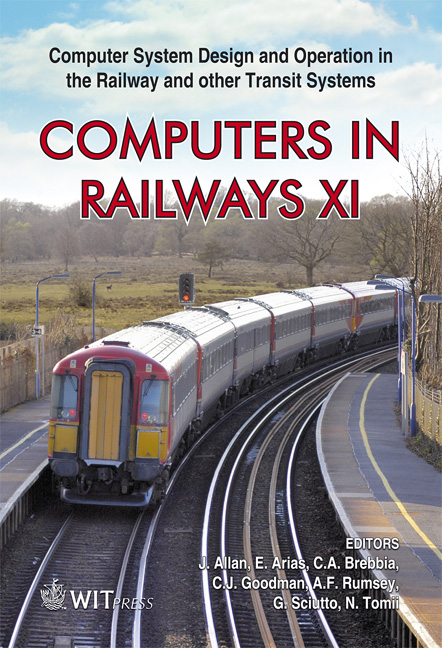
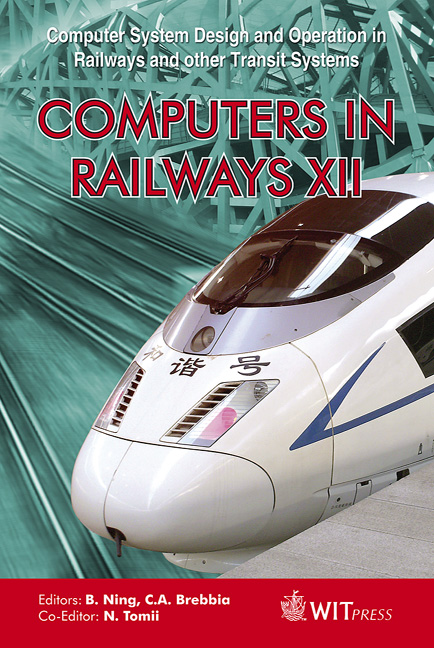
Computers in Railways XI
Computer System Design and Operation in the Railway and Other Transit Systems
Edited By: J. ALLAN, United Kingdom, E. ARIAS, Spain, C.A. BREBBIA, United Kingdom, C. GOODMAN, United Kingdom, A.F. RUMSEY, USA, G. SCIUTTO, Italy and N. TOMII, Japan
Price:
USD594.00
ISBN: 978-1-84564-126-9
eISBN: 978-1-84564-348-5
Pages: 896
Book Series: WIT Transactions on The Built Environment
Series Volume: 103
Published: 2008
Hardback
Book Description
COMPRAIL 2008 the eleventh in a series of well-established and successful international conferences on Computer System Design and Operation in the Railway and Other Transit Systems, was held in Toledo, Spain, in 2008. Since 1987, COMPRAIL has provided a world forum for planners, designers, manufacturers and operators to discuss how they can benefit from computer-based techniques.
This book contains most of the papers presented at COMPRAIL 2008, representing the latest research, development and application of computers to the management, design, manufacture and operations of railways and other passenger, freight and transit systems.
The Conference attracted a large number of papers, divided into the following sections: Planning; Safety and Security; Advanced Train Control; Communications; Energy Management; Power Supply; Operations Quality; Timetable Planning; Level Crossings and Obstacle Detection; Computer Techniques; Dynamics and Wheel/Rail Interface; Maintenance; Rolling Stock; Training Tools and Technology.
Book Contents
Method and software tool for an optimized passenger orientated connection management
M. Klemenz; A. Radtke;
FASTA: a new life for a former dinosaur adapting the modelling scope to new planning requirements
P. Tzieropoulos; A. Curchod; Y. Putallaz;
Analyzing and forecasting railway data using linear data analysis
E. T. Selig; G. M. Cardillo; E. Stephens; A. Smith;
Using a rail simulation library to assess impacts of transit network planning on operational quality
E. M. Kanacilo; N. van Oort;
Analysing the Metro Cityring in Copenhagen
A. H. Kaas; E. M. Jacobsen;
Capacity measurement with the UIC 406 capacity method
A. Landex; B. Schittenhelm; A. H. Kaas; J. Schneider-Tilli;
RAILONOMICS – determining investment strategies for railway signalling through simulation
K. Beck; B. Scheier; B. Jäger;
Applying the lessons learnt in Asset Management around the world to the development of the AMPLE tool
A. J. Howard;
Banverket capacity consumption, congested infrastructure and traffic simulation with Railsys
M. Wahlborg;
High-speed lines (HSL) as an environmentally friendly transportation system – the Polish case
W. Czyczula; S. Lisowski;
Safety concept of railway signalling based on Galileo Safety-of-Life Service
A. Filip; J. Beugin; J. Marais; H. Mocek;
A safety-related transmission method for a new railway signalling system based on an IP-Network
M. Endo; T. Okada; D. Watanabe; K. Aimi; T. Kunifuji; M. Matsumoto;
A Discrete Time Markov Chain approach to global risk analysis in railway transportation
P. Cesario; N. Sacco; M. Sciutto;
Software RAMS: the opportunity
Y. González-Arechavala; J. A. Rodríguez-Mondéjar; G. Latorre-Lario;
Industrialising a proof-based verification approach of computerised interlocking systems
S. Behnia; A. Mammar; J.-M. Mota; N. Breton; P. Caspi; P. Raymond;
Taking advantage of some complementary modelling methods to meet critical system requirement specifications
F. Defossez; P. Bon; S. Collart-Dutilleul;
SPAD – reducing timetable related risk
H.-H. Kohls; R. Watson;
Multi-objective optimization method for the ATO system using Cellular Automata
J. Xun; B. Ning; K. P. Li;
Computer-aided design of ATO speed commands according to energy consumption criteria
M. Domínguez; A. Fernández; A. P. Cucala; L. P. Cayuela;
Evaluation of the capacity limitations and suitability of the European Traffic Management System to support Automatic Train Operation on Main Line Applications
P. Thomas; D. Fisher; F. Sheikh;
Development of a LRT simulator for demand forecasting
N. Kudo; T. Mizuma;
ERTMS Level 2: effect on capacity compared with “best practice” conventional signalling
W. A. M. Barter;
Enhanced ETCS_L3 train control system
D. Emery;
The impact of GSM-R on railway capacity
D. N. Jansen; S. G. Klabes; E. Wendler;
Towards interoperability on Northwest European railway corridors: signalling on the high-speed railway Amsterdam–Antwerp
J. H. Baggen; J. M. Vleugel; J. A. A. M. Stoop;
Basic train control system for regional branch lines – field test report
B. Stadlmann;
A new tool for railway planning and line management
J. Garzón Núñez; J. de D. Sanz Bobi; J. Gómez Ramírez; J. Cano Nogueras;
Analysis of braking performance for the definition of emergency braking intervention in ATP systems
M. Malvezzi; F. Bartolini; M. Rinchi; A. Rindi;
Operation simulation of traction systems
L. Abrahamsson; L. Söder;
Development of a high-speed rail transmission system using digital signal processors for railway signalling
H. Mochizuki; S. Takahashi; H. Nakamura; S. Nishida; R. Ishikawa;
A location-based MAC protocol for safety-of-life vehicle-to-vehicle communication
C. R. Garcia; T. Strang; A. Lehner;
Experimental evaluation of a telecommunications network along railway lines by ad hoc network technology
K. Seki;
Robust data transmission with eddy current sensor system
S. Hensel; C. Hasberg; R. Rütters;
Charge/discharge control of a train with on-board energy storage devices for energy minimization and consideration of catenary free operation
M. Miyatake; K. Matsuda; H. Haga;
Evaluation of energy saving strategies in heavily used rail networks by implementing an integrated real-time rescheduling system
M. Luethi;
A production train diagram of train control to save power consumption used for dynamic programming
T. Katori; T. Izumi;
A three dimensional model for the mechanical study of railway catenaries
J. Benet; T. Rojo; F. Cuartero; E. Arias;
Adapting the CIM model to describe electrified railway systems
R. Santodomingo; E. Pilo; J. A. Rodríguez-Mondejar; M. A. García-Vaquero;
Optimal design of power supply systems using genetic algorithms
J. R. Jimenez-Octavio; E. Pilo;
Application of linear analysis in traction power system stability studies
S. Danielsen; T. Toftevaag; O. B. Fosso;
Fast estimation of aggregated results of many load flow solutions in electric traction systems
L. Abrahamsson; L. Söder;
DC protection calculations – an acceptable approach
R. Leach; D. Tregay; M. Berova;
A study of corrosion of zinc-coated stranded steel wire used as messenger wire
T. Kuraoka; Y. Sato;
OpenPowerNet – simulation of railway power supply systems
A. Stephan;
Performance analysis: improving the Dutch railway service
V. A. Weeda; K. S. Hofstra;
Automatic identification of route conflict occurrences and their consequences
R. M. P. Goverde; W. Daamen; I. A. Hansen;
A Petri nets based decision support tool for railway traffic conflicts forecasting and resolution
S. Ricci; A. Tieri;
An incremental decision algorithm for railway traffic optimisation in a complex station
J. Rodriguez;
Improvement of a railway planning tool using Genetic Algorithms
J. de D. Sanz Bobi; J. Gómez Ramírez; J. Garzón Núñez; R. Galán López;
Day-to-day tuning of the Tokaido Shinkansen timetable – carried out for every single operating hour throughout the year
H. Ogawa; S. Kawai; Y. Kojima; M. Goto; H. Shoji;
Development of a dwell time calculation model for timetable planning
S. Buchmueller; U. Weidmann; A. Nash;
Comparing the effectiveness of two real-time train rescheduling systems in case of perturbed traffic conditions
S. Wegele; F. Corman; A. D’Ariano;
Evaluation of punctuality on a heavily utilised railway line with mixed traffic
O. Lindfeldt;
Real-time asynchronous conflict solving algorithms for computer aided train dispatching assistance systems
A. Kuckelberg; E. Wendler;
A novel train rescheduling algorithm for correcting disrupted train operations in a dense urban environment
K. Kumazawa; K. Hara; T. Koseki;
Automated analysis of train event recorder data to improve micro-simulation models
S. de Fabris; G. Longo; G. Medeossi;
Automatic generation of car shunting scheduling in railway car depots
Y. Nagasaki; S. Takahashi;
Applying multiscaling analysis to detect capacity resources in railway networks
A. Gille; M. Klemenz; Th. Siefer;
TTPlib 2008 – a library for train timetabling problems
B. Erol; M. Klemenz; T. Schlechte; S. Schultz; A. Tanner;
Obstacle recognition from forward view images from trams
H. Miyayama; T. Ohya; T. Katori; T. Izumi;
The methodology development of railway level crossing safety systems – South Australia case study
S. Z. Ishak; W. L. Yue; S. V. C. Somenahalli;
The multi-agent programming paradigm use for railway applications
F. M. Rachel; P. S. Cugnasca;
Train control language – teaching computers interlocking
J. Endresen; E. Carlson; T. Moen; K. J. Alme; Ø. Haugen; G. K. Olsen; A. Svendsen;
Study on the influence of track conditions on dynamic wheel load variation
Y. Kawasaki; M. Miwa; A. Yoshimura;
Dynamic vehicle response on horizontal curves equivalent to turnout curves through Swedish UIC60 turnouts
B. Kufver; O. Rydell;
Digital inertial algorithm for recording track geometry on commercial shinkansen trains
M. Kobayashi; Y. Naganuma; M. Nakagawa; T. Okumura;
Simulation of railway track deterioration influenced by ballast stiffness and dry friction
J. Droździel; B. Sowiński;
A study on the evaluation method of the characteristics of the contact point between wheel and rail
M. Adachi; T. Shimomura;
Influence of vehicle unsprung-mass on dynamic wheel load
M. Miwa; Y. Kawasaki; A. Yoshimura;
Characteristic identification of oil dampers for railway vehicles using Neural Networks
R. Koganei; K. Sasaki; N. Watanabe;
, a new UIC simulator for the longitudinal dynamics of trains
L. Cantone; L. Müller; D. Negretti; V. Vullo;
On the evaluation of wheel sets and railway track quality
R. Bogacz; P. Meinke; B. Zając;
Efficient maintenance strategy through System Dynamics
T. Böhm; K. Beck; A. Knaak; B. Jäger;
A model for the life expectancy of railway switches and crossings for maintenance and renewal planning in asset management systems
W.-J. Zwanenburg;
Measurement of vehicle ground speed with inertia sensors – computation issues
T. X. Mei; H. Li;
The connected IP train and interdependent integration at the control centre
V. Scinteie;
Visualization study of the influence of parapets on the flow around a train vehicle under cross winds
M. A. Barcala; J. Meseguer;
A computer tool for automatic braking distance calculation
C. Sicre; A. P. Cucala; A. Fernández; L. Cano;
Technical development at the 2TRAIN project
J. M. Mera; L. Brue; M. Hintenender; A. Gil; L. M. Gutierrez;
The use of computer-based training tools in Europe – an overview and new approaches
M. Schmitz; C. Maag; J. M. Mera;
The new driving and faults solving simulator for the Madrid light rail system
L. M. Gutierrez; J. M. Mera; E. Castellote; A. Garcerán; F. Ariza;
Simulation of the ASFA system in an ERTMS simulator
I. Gómez-Rey; J. M. Mera; A. Lorenzo;
(This link will take you to an external website)